Learning Chinese is a lifelong pursuit. The language doesn’t have an alphabet, requires tonal pronunciation, and lacks many shared cultural reference points with other languages. If you are learning Chinese, you have already discovered that you need humility, patience, and determination to avoid a mental breakdown when unable to fully comprehend a menu at a Chinese restaurant — even after studying the language for many years.
Because Chinese is so difficult, learners must be resourceful. You may diligently compile paper flashcards, research the most effective textbooks, and even use Chinese-speaking Uber drivers as your short-term language partners.
You’ve also probably downloaded at least one of the hundreds of mobile apps that promise mastery of this ancient language without having to leave your couch.
But most of those apps will only take you so far with Chinese. Not because they are bad apps, but because most of them were built to solve a different problem than the one you run into a year in.
Here’s what’s going on and what you can do about it for your learning.
Most language learning apps aren’t designed specifically for Chinese
Chinese is unique among most modern languages. When a native English speaker is learning a French word, all they need to remember is the word’s English definition. There are also plenty of cognates (words that share the same origin) to help you along the way. Pop quiz, what does the word horrible mean in French? You win, it means horrible.
However, when learning a Chinese word you must remember the character(s), the English definition, and its pinyin pronunciation. Without an alphabet, the way a character is written usually provides no indication of how the word is pronounced. Learners also need to master terms and idioms that are specific to the cultural context of Chinese. These words often don’t map cleanly to words and phrases commonly used in English.
This is where most apps fall down.
Most apps are designed to get as many people to use them as possible. The easiest way for a language learning app to increase installations is to offer support for additional languages without changing the fundamental design of the app. For Chinese, this often means that users only review the character and its pinyin pronunciation together or only learn the word’s pinyin pronunciation and definition together. Additionally, words and concepts that may be essential in Chinese, but are uncommon or nonexistent in English, are nowhere to be found.
An app built to serve many languages at once has a hard time accommodating what makes Chinese different, and learners feel that gap fairly quickly.
Most apps are made to keep beginners hooked
Apps that are made specifically for Chinese have their own issues. Have you ever downloaded a Chinese learning app only to find yourself reviewing “red”, “mom”, and “cow” for the hundredth time? Answering correctly still sets off the little burst of stars, and that reward is doing real work. It is what keeps people coming back.
Many apps have a step-by-step, game-like progression to keep you engaged. Here is the founder of Duolingo from David Freedman’s article in The Atlantic.
“The biggest problem that people trying to learn a language by themselves face is the motivation to stay with it,” he told me. “That’s why we spend a lot of our energy just trying to keep people hooked.”
That is a reasonable thing to optimize for. Motivation really is the hardest part of studying alone, and a game-like progression solves it well. The trade-off is that a fixed path restricts what you study and when, which serves people less well once their goals diverge. To keep learners engaged for the long term, the content of the app needs to match a learner’s purpose for studying the language and grow with them once they are no longer beginners.
What if you’re working towards reading political primary sources, or moving to China to teach English? These two learners will have completely different needs and objectives. A single shared path cannot serve both of them well, and the time goes somewhere other than what each one actually needs.
Further, Chinese learners do not stay “beginners” for long. In order to attain a large enough vocabulary to read independently, a learner needs to recognize thousands and thousands of characters, far beyond the scope of apps that are designed for new learners.
That design serves beginners genuinely well. It is simply not built for the stage where the work becomes accumulating thousands of characters.
Most Chinese language apps try to do too much
Apps are not great tools for teaching complex tasks. They are designed for simple transactions that can be completed wherever you happen to be. Checking your bank statement? Awesome. Learning the fundamentals of fractional reserve banking and its influence on different financial systems? Not helpful.
Mastering Chinese, like any foreign language, involves learning to speak, listen, write and read — plus the requisite cultural understanding. No language app can provide you with the type of sustained immersion required to master these complex skills.
The good news is that there is an aspect of learning a language that is “transactional” in nature, and that’s learning vocabulary. Learning vocabulary is particularly essential for Chinese because the language lacks an alphabet. Once you’ve learned the fundamentals of characters, growing your vocabulary comes down to dedicating time to memorizing the thousands of characters required to operate effectively in the language.
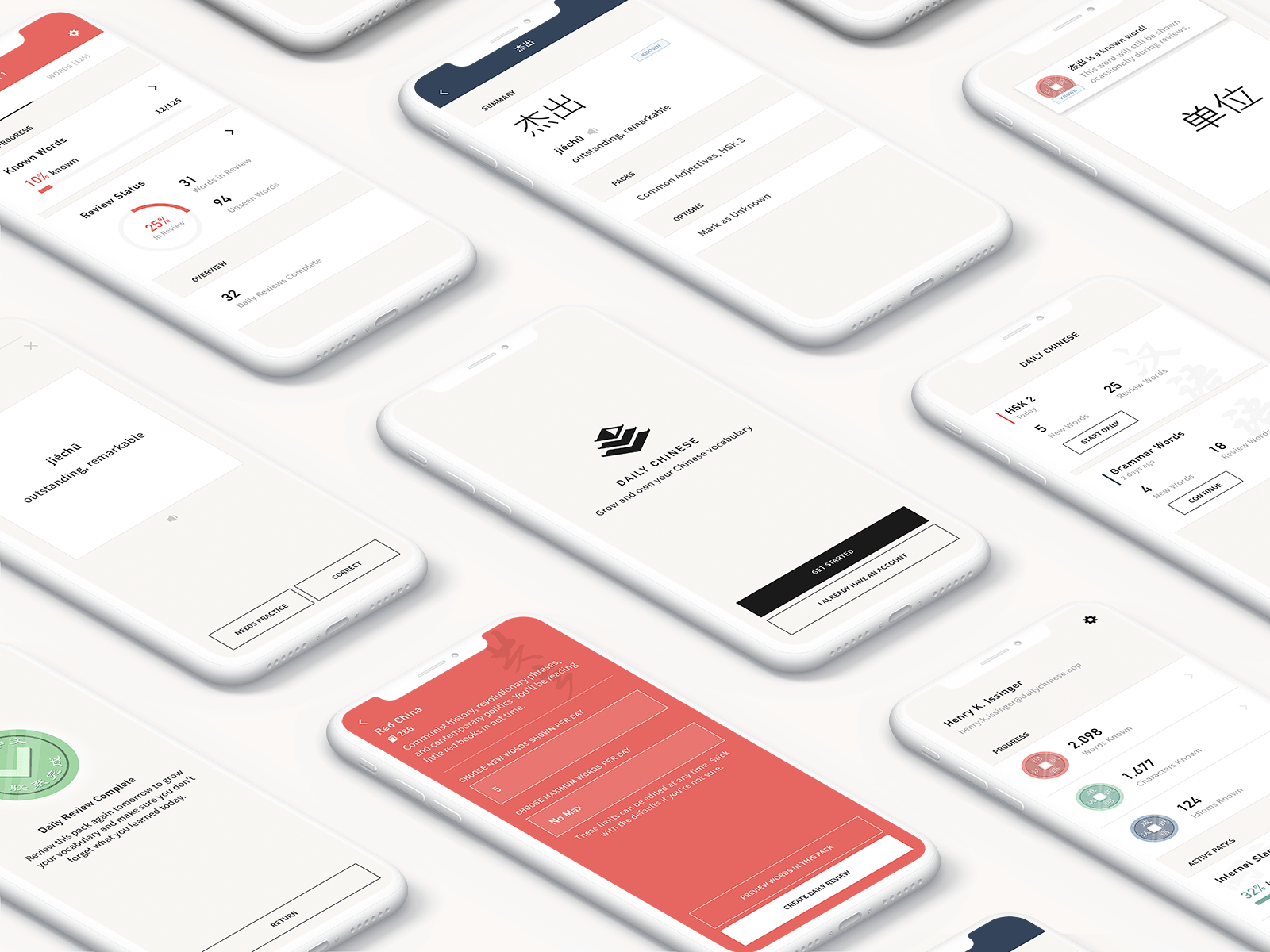
We created Daily Chinese to do that one part well. With a clean, minimal interface designed specifically for Chinese, it focuses on growing your vocabulary rather than promising fluency.

Daily Chinese uses a spaced repetition system to gradually introduce new words each day and ensure you never forget what you’ve already learned. You can create daily reviews from over 20,000 total words assembled into useful, practical word packs. Learn the basics, master idioms, ace grammatical concepts, pass the HSK, survive abroad, get the job, and much more. As you complete daily reviews, your progress is tracked so that you always know the size of your vocabulary.
Daily Chinese is available for free on both iOS and Android.
Let’s simplify Chinese learning and stop wasting time.